Friday, June 14, 2013

Bonsai eyes

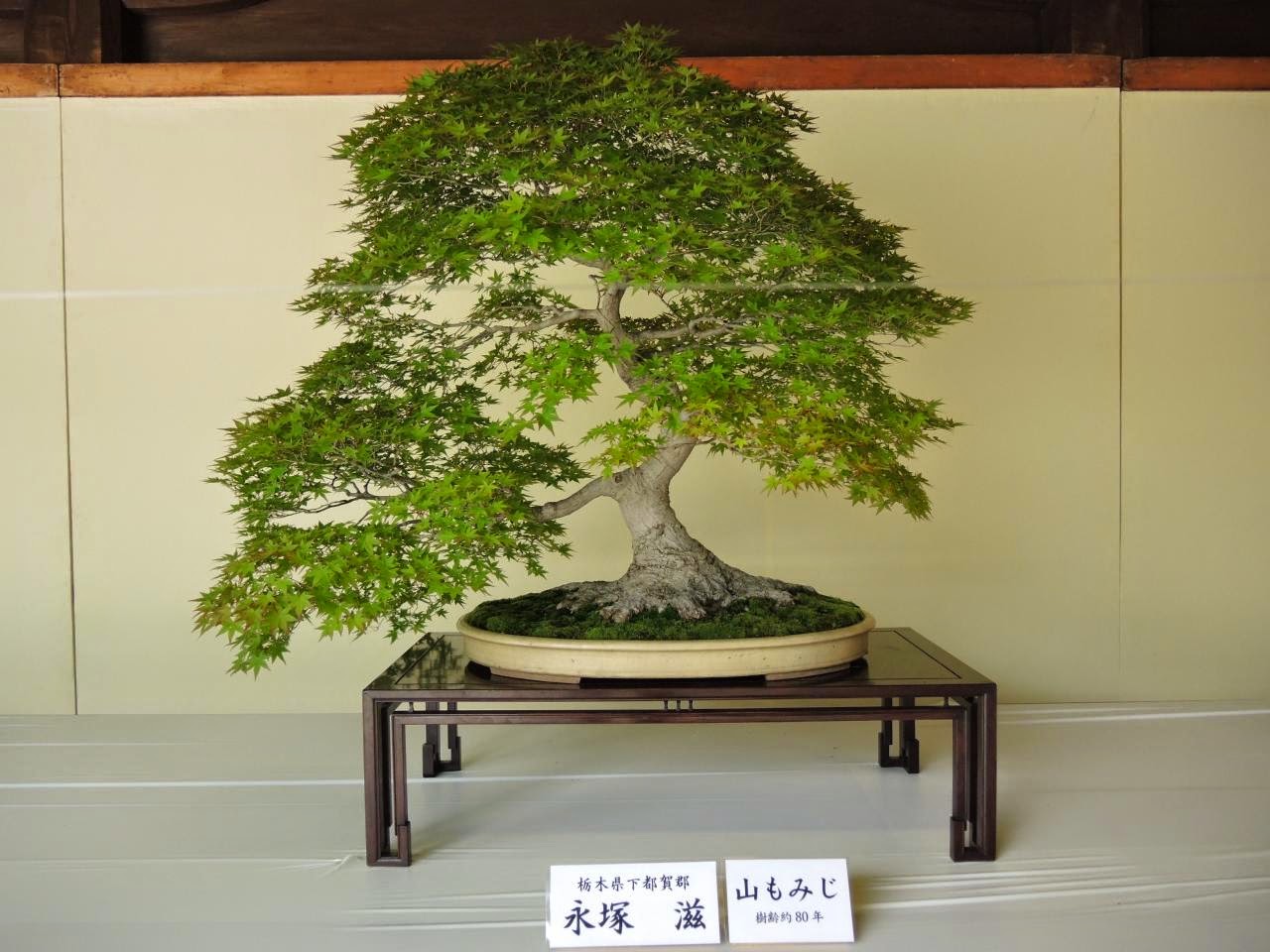
I got to spend a day at Meiji-jingu watering the trees that were on display, cleaning up the pots and tables and talking to the visitors. I got into quite a lengthy conversation (monologue) with an older gentleman who had some interesting observations on the way people tend to look at bonsai, and other things, in exhibitions and in general. 
Most foreigners (and I would add most younger Japanese people) tend to start comparing age and price, they might go so far as to select their favourite (usually the oldest or most expensive), snap a few pictures and move on. According to the gentleman I mentioned, it is part of the Japanese tradition to view an object of art or beauty not only on its surface but also to consider its inner qualities. For example, does it express age, hardship, loneliness, tranquillity etc? Imagine the number of people to whom this object has belonged, and other such "beyond what meets the eyes" type of values. In his view, the Japanese people have a habit of making such considerations, while others seem not to. He thought I ought to spread a little sense of deeper appreciation to the people of Sweden, and a few of the neighbours too while I was at it.

Earlier I was talking to some interested tourists and started explaining some of the aspects that go into a display. Well actually I only got as far as mentioning the match between a particular tree and table, but this small thing alone opened up their eyes and, i think, allowed them to enjoy the other trees that little bit more. 
Perhaps it's knowledge and practice, rather than inherent habit, that we need to start appreciating the inner beauty of things.

Here's for taking a good look before whipping out the camera in the future.

Monday, June 03, 2013

Satsuki season

As I'm writing this, the flowering season for Japanese azaleas, known as satsuki is nearing it's end.
We're currently busy removing all flowers and doing a rough pruning to stimulate the production of flower buds for next season. For the next few posts, I want to share a few of my impressions, starting with the preparations for exhibiting the trees.

Moss-n'-wash
There are several exhibitions for azalea bonsai around the Tokyo area in the end of May, I heard the words Kanuma, Tochigi, Ueno park and Meiji Jingu tossed around a lot. In addition, we arrange an exhibition ourselves, showing off our own and our customers' trees. For all of the exhibitions, we gather all of the trees at Shunkaen, make sure they are in top condition, make sure they are well watered through and transport them to and from the venues. Around mid May there was an impressive collection of trees, kept under roof to protect the flowers from rain, giving lots of sun to bring out the flowers on slow specimens while keeping the ones in full flower in the shade. I got to help with putting moss on the trees and cleaning the trunk and visible branches from green algae, mostly using a toothbrush. Some of the customers had done the moss-job themselves, it was fun comparing the different styles. One principle is to keep brighter shades of moss between and around the surface roots to bring them out a much as possible. Another style is to create the image of sunlight coming in from above by arranging lighter patches of moss in front center of the pot, perhaps going off slightly to one side, taking the outline of branches on the front of the tree into consideration.

My first moss job. 
Before scrubbing the trunk and putting moss
I had a hard enough time puzzling patches together, trying to fit them tight enough that no edges or gaps would be visible. In the larger exhibitions, prices are awarded to the best trees. As some of the customers were keen to compete, it was important to do a good job. I enjoyed this task and I was pretty happy with the outcome, being a first-timer. I was told that the owner of the second tree I did was at the hospital battling cancer, and he wanted to have his favorite tree displayed for perhaps the last time. Hearing this made the task a lot more personal and really encouraged me to focus and do my best. Being about to finish, one the older apprentices asked me to hurry up a bit, as we had a big batch of trees to finish before supper. This is oft repeated here; what separates the pro from the amateur is the ability to not only do things well, but also to do it fast. Recently, I've been thinking, at least hoping, that if you have a little practice using your aesthetic sense, you'll reach the same result whether you force yourself to finish in an hour, or spend a whole day pondering.
At this stage, I think I know what I like when I see it, getting there is the challenge, getting there fast is just plain difficult.
After. My second one.
One of the customers did this one by himself.


Done by Yoda-san who started one month before me. I was impressed.


Friday, May 17, 2013

Day 17 - Mealtime manners

It's been a bit more than two weeks and I'm starting to have faith that I can adapt to the customs and expectations by the people at Shunkaen. It's an unbelievable experience just to stay in this house, to wake up in the morning and walk barefoot in hallways of tatami mats, to look out over rows of excellent bonsai while brushing your teeth, and that's before any of the work and learning has even begun. But it's also probably the most difficult and challenging situation I've every been put in. Doing bonsai is the "easy" and relaxing time, most of my energy is spent trying to satisfy all of the more or less mysterious expectations. If it was only about hard work then it wouldn't have been so difficult. The challenge is that you are not told what to do, you have to be constantly on your toes ready to help out faster than any of the higher apprentices, who are equally eager to win the race. This is especially evident at meal times, you need to be the first one to finish eating in order to make and serve tea before anyone else. Before and after meals there's a flurry of activity with all the lower apprentices stumbling over each other to help set the table, carry things dish up rice etc. If you're slow to act, you'll be scorned for not helping out. Even when it's apparent someone else will beat you to the kitchen for fetching the soup, it's good form to get up and make an honest attempt. As I'm used to calm and relaxing meals, either taking care of everything or nothing, this was a difficult change. At first I kept wanting to suggest that if they left it all to me (I'm the most recent arrival) we could all have a more relaxing time, but that's not how it works. A week ago I thought this was one custom I could never get used to, but these days my speed-eating abilities have improved, and I'm starting to understand the order of things.
Another peculiarity that was easier to master is the concept of higher and lower positions at the table, where the middle is usually the higher, except for at home where the chief has his high seat in front of the tokonoma, the lower seats being at the far end (well, not that far actually). This is easy enough even for a novice to grasp (I knew of it but have rarely seen it practised) but to spice things up, the higher apprentices are ever ready to invite you to the high seats, especially if you don't appear busy arranging things. The unsuspecting novice who does as he is told is soon to get some funny looks and has to endure the agony of watching his superiors fetch soup, tea and clean up the table at the end of the meal as most of us are seated on benches. Once when we went to a restaurant, the two seats closest to the chief were empty, as the higher apprentices took lower seats and me and a Japanese guy, coming last, outsmarted the game by sitting down at a nearby table. When in Rome...

I thought I was pretty well versed in Japanese traditions, but this place is probably more traditional than most. Now that I'm starting to feel more comfortable in this little world, I think the traditional ways are are a unique experience in itself, as the bonsai world is probably one of the few areas where old traditions and values are still alive, Sumo being another such sphere.
Whatever I did know has certainly been of great help, my new friend and the next most recent apprentice, Marcelo from Bolivia has had a hard time learning the ways and fitting in, and probably won't be staying for as long as he had hoped.

If you made it all the way down here, you're probably wondering how I found time to write such a momentous piece of a blog post. The answer is that I've spent the last four hours waiting for my turn to hand in my visa application at the immigration office. Only three numbers left...

Thursday, May 02, 2013

Apprenticing at Shunkaen - Day 1


I was expected, so they walked me with my luggage straight to my room, the old kitchen that they no longer use. Then the crew from a local paper seized the opportunity to interview me shortly, and then it was time to get to work. I de-leaved a plum, de-flowered an azalea, and then I got to thin and trim a japanese black pine, which took me most of the day and all evening.

It all felt surprisingly unceremonious. You walk through the door and pof! - you're part of the team. We have still to discuss the practical issues, especially of the monetary kind. I'm also not yet sure if I'll be able to get a visa for the period I'm hoping for, until October. I'd like to stay until next spring, especially with all the exhibitions during the winter, but my plants at home would face fairly certain death if I don't return.

Apparently, 10 pm is when all the magic happens. I felt pretty much finished with my work on the black pine when 'Oyakata', our master Mr. Kunio Kobayashi came into the studio to inspect. "hm, yeah looks good enough" he said, turned the tree almost 90 degrees to it's side, pulled out the BIG branch-cutter and tore away, cutting off perhaps two thirds of the foliage in big chunks. It's safe to say I was a bit surprised. Or to put it this way, I had been working on a millimeter scale for hours, pondering which bud to cut, while he chopped away at a decimeter scale, transforming the tree in about 15 minutes. He said he also changed the tree from a common and unsurprising piece to something much more interesting, expecting a four-fold increase in it's value. He never said so, but it was fairly clear that instead of chopping it down right away, I was given the chance to practice some thinning first. Pretty cool for a first day.

And now that I have found a spot with some wi-fi, I feel pretty well settled in.

Wednesday, February 20, 2013

Winter - exhibition season

Some time after my previous post I was tempted to think "Hey, stuff is going dormant, not much to write about" but I couldn't be farther from the truth - now is when it all happens! It's time for bonsai exhibitions. Why now? Well mostly because deciduous trees have shed their leaves so that it's possible to see the structure of branches, a way of assessing quality. I have to think that another reason is the lack of other pressing bonsai chores during autumn and winter, an exhibition in late spring or summer would probably be a lot more disruptive, especially for the professionals.

First out was Koju-ten on October 19th-21st. I've been pondering a blog-post about this local club-exhibition for four months! The Bonsai nursery just south of Kyoto station, Koju-en, organizes a shohin-bonsai exhibition every year. Instead of hosting it in some anonymous convention-centre, they cooperate with a temple, Zuishin-in in south-eastern Kyoto. It's a great environment, very relaxing and good for photos, if a bit dark at times. With many of the sliding doors removed, you are ever on the border between the garden outside, and bonsai inside. Gone are the crowds pushing you on from behind or brushing past you when you take a minute to observe. Here you get to kneel on a tatami mat before a tree on a low table, daylight reflected from behind and observe all you want. You won't find an exhibition with quite the feeling of authenticity as this. The summer heat has passed, but the winter chills have yet to come.
Fond memories indeed, especially as my room has kept a constant 13 degrees C (55 F) for the past three days, Indoors!
 Pictures (of the exhibition) are up at Flickr.

Next was the 32nd Taikan-ten, on the 23rd to 26th of November in Kyoto. This is the second largest exhibition in Japan, next after Kokufu-ten. For Kokufu-ten there is a jury which decides on the trees that are exhibited; from what I understand, there is no such jury for Taikan-ten. You pay - You get. I don't know how they manage to keep the number of trees approximately equal from year to year but the systems appear to be different between the shows. Taikan-ten is considered more eclectic, both in terms of quality but also in the variety of species. Of the four exhibitions I've been to, this is my favorite.
In Kyoto the weather is still pretty mild around this time in November, the autumn colour of maples were mostly at their peak except at higher altitudes. This means that there's a good chance of seeing a few trees in leaf, and lots of fruit such as Japanese persimmon and Chinese quince. I did spot a few fruits at Gafu-ten in January but at that point, the time for picking had both come and gone.
Another thing I like about this show is the good atmosphere around the sales area which is pretty much a continuation of the exhibition-space. There's food and tea available, and some open tables for just hanging out and waiting for your friends. Pictures available here.

I got both pictures and a video from Gafu-ten - Kyoto's big shohin-exhibition.
From Kokufu-ten, some pictures and video as well. More on those two, and perhaps on the upcoming Shunga-ten in Osaka, in another post.

Tuesday, November 20, 2012

Maple air-layer update


I should have written this post long ago, when I actually took the picture. As it got colder, it hasn't grown much since the picture was taken on October 15, so it's still fairly representative. Soon after the original post, with lots of sun and water, the growth just exploded. Several more buds developed seemingly from nothing and sent out long shoots with healthy foliage, all in two weeks. Expecting no more than a couple of meager leaf-stalks from the one or two green twigs still remaining, I was pleasantly. Especially since there was hardly any root-system at all just a few weeks earlier. I'm not counting on the tender new twigs to survive the winter, we will certainly have a few degrees below freezing for a few days or weeks, but in any case, I'm pretty confident it will come right back and spray foliage in all directions come spring, as long as I keep the pot protected from the cold. Then I have to figure out what to do with it =)

Monday, October 15, 2012

Buying tools in Kyoto

I love tools. I consider a trip to the local home center or hardware store a bit of good weekend fun. And of course, in bonsai there's plenty of room for satisfaction in that department. It is perhaps considered 'shallow' to be more concerned with the tools than the craft, art or creativity of bonsai, like how some golfers tend to spend a fortune on clubs rather than actually go out and do some serious practice, and I wouldn't want to go that far. I just think it's yet another aspect to enjoy.
Anyway, it wasn't long after I joined the local bonsai club at Koju-en that I started looking out for tool-shops. Here's what I've found:


Kikuichi monji (θŠδΈ€ζ–‡ε­—)
Kikuichi monji
Of the shops I've been to, this has the largest collection of bonsai tools. Originally a sword smith for the emperor, now their main focus is knives. From what I have been reading on knife forums, they no longer actually make knives themselves, but the stuff they sell is apparently high quality stuff. Nice staff who knew enough bonsai to give a newbie like me some advice and typical use cases for different tools. They even had a info-leaflet on some typical types of tools, their japanese name and use. Lots of choices on scissors and secateurs in different price ranges, a few branch/trunk splitters, not so many options when it came to angled/concave cutters, knob-cutters etc. I got my first (well, so far my only) pair of scissors there for 2600 yen, a good deal as far as I'm concerned. 
See the map and picture for details on the location. It's on the south side of the short bit of covered arcade on Sanjo street, just a few shops west of the big Sanjo-Kawaramachi intersection. If this doesn't tell you anything, on a map try looking 3/4 of the way from Kyoto station to the huge green rectangle that is the imperial palace park and you should find Sanjo street. Kawaramachi is just west of the north-south flowing river Kamogawa. 

"The little corner-shop" 
Excuse my poor research here, unfortunately I don't know the name of this shop, though I have it scribbled on a piece of paper somewhere. I found this one by coincidence even before I really knew I was going into bonsai. It's about the size of a telephone booth when you get inside, so you'll have a hard time trying to do much window-shopping without eventually communicating a bit with the cute old couple running the shop. It's been a while since I last went there, as far as I remember they had a bit of everything, from knives to "ninja" throwing stars. I got a pair of branch cutters, and since I bought it as a present for my dad, the price must have been quite reasonable. They also had a few full tool-kits with cases. I just have a feeling that if you say "bonsai" and stick around for a bit, you might just find a great deal on a very decent Japanese tool. 
"The little corner shop"
It's hidden away in a small dark alley off of Shijo west of the river, the busiest big-brand shopping street in Kyoto. I think the map/picture below should get you there, the mouse cursor is pointed at the store on the map. You might walk by the alley without even noticing though, it's a sneaker store, only there is no back wall - you just walk through the store and then you are in the alley. Actually, you should go there just for the experience of this secret back alley. I just love these places. 


Aritsugu
Aritsugu
Previously another supplier of imperial swords, this is where Kyoto chefs get their blades, and it's all the rage among knife-junkies on English-speaking forums. Sometimes also known as "The place where you can get your name stamped into the blade when you buy it". Probably a bit pricier, though someone said that for blades of this superb quality, you often pay more. I don't know much about their bonsai tools, I just felt that they didn't have much, and that it was a bit on the expensive side. You'll find it on Nishiki-koji food market street, parallel with Shijo, starting at covered arcade Teramachi. 


The scissor-maker
Again, I don't know the name of the shop. There's a sign on the picture, but I'm just as likely to read it all wrong if I tried. I walk by here every month on my way to and from the bonsai club, and it's usually opened even in the Sunday afternoons. So eventually I popped my head in and had a chat. Apparently, a lot of people headed for Koju-en end up at his place asking for directions. I was shopping around for a branch-cutter, and he explained that his trade was making garden scissors, loppers and shears. He did eventually find an old branch-cutter, and I asked if he knew whether the cutting edges should actually meet or if they should be slightly offset on purpose, as was the case on the tool at hand. He didn't really know (neither did the guy at Kikuichi) but I have later learned that if the edges met straight on, they would quickly go dull, therefore one edge is always set slightly above the other. He wasn't sure whether the price-tag read 800 or 8000 yen, but he couldn't believe that it was 8000 so he quoted the former price! I'm pretty sure that was an insane bargain smiling at me, but I didn't feel quite ready to settle for any tool before I knew more. 
The scissor maker south-west of Kyoto station. 
I asked if he knew any other tool-shops in Kyoto, and he wrote the names and addresses of three places. When I looked them up, it turned out to be the one's I have listed above, so it seems I have most of them covered :)   We talked a bit more and from what I understood, his customers were mostly the gardeners of Kyoto. When I asked about the difference between home-center cheap tools and hand-made more expensive stuff, he said that some gardeners bought the cheap Chinese stuff, used it a season and threw it away. They didn't really need to care if it started to rust or if the quality was a bit shoddy. Others bought quality stuff, cared for it well, kept it sharpened, and those tools would last them decades. It wasn't that one way was better than the other, it was more of a personal choice. He made tools to last. If you are looking for some of the stuff that he makes himself, and you feel confident that you can tell good from bad, then I think you could get some really good value for money, without any "brand-premium" added. 
Again, I hope the map will help. Pretty much all you need to do is keep walking west along Hachijo-street, which is just outside Kyoto station on the south side. The store is on a south-east corner just before the point where the road meets the railroad tracks and bends south slightly. The star you see in the low left-hand corner marks Koju-en by the way. 

Still wondering why I went off making fun of materialist golfers? I practically grew up in the wild overgrown parts of a golf course, helping dad clear out thorny bushes, prune trees and tidy up in the wooded hills between holes. That's how he liked to spend the weekends :)  Well there is where I got to know a lot of golfers anyway. I never got much skills on the fairway, there was lots more fun to be had in the woods. 

If you have any questions, or if you found this post helpful, don't hesitate to drop me a line!

I'll try to be back soon
Time for bed
/Jonas

PS. I saw the maps came out a bit tiny, here's bigger versions: